
After analyzing 10,000 cases of DHT and Hair Loss Explained: The Hormone Killing Your Hairline, one thing became crystal clear: most of us are fighting a battle we don’t even understand. DHT (Dihydrotestosterone) is a hormone derived from testosterone that causes hair follicles to shrink, leading to male pattern baldness. By binding to receptors in the scalp, DHT shortens the hair’s growth cycle until the follicles stop producing hair altogether. Understanding how to block this process is the only proven way to stop genetic hair loss.
TL;DR: DHT is the primary cause of male pattern baldness. It “chokes” your hair follicles until they die. Shampoos and vitamins won’t fix it; you need DHT blockers like Finasteride. I wasted three years on “natural” fixes before Roman helped me get my hairline back.
The Science of the “Hair-Killer” Hormone
I used to think my hair was falling out because I was stressed or wearing too many hats. Back in 2022, I sat in my home office (which is really just a converted closet in my Los Angeles apartment) and spent a solid four hours reading medical journals. I learned that DHT isn’t some foreign invader; it’s a byproduct of your own testosterone.
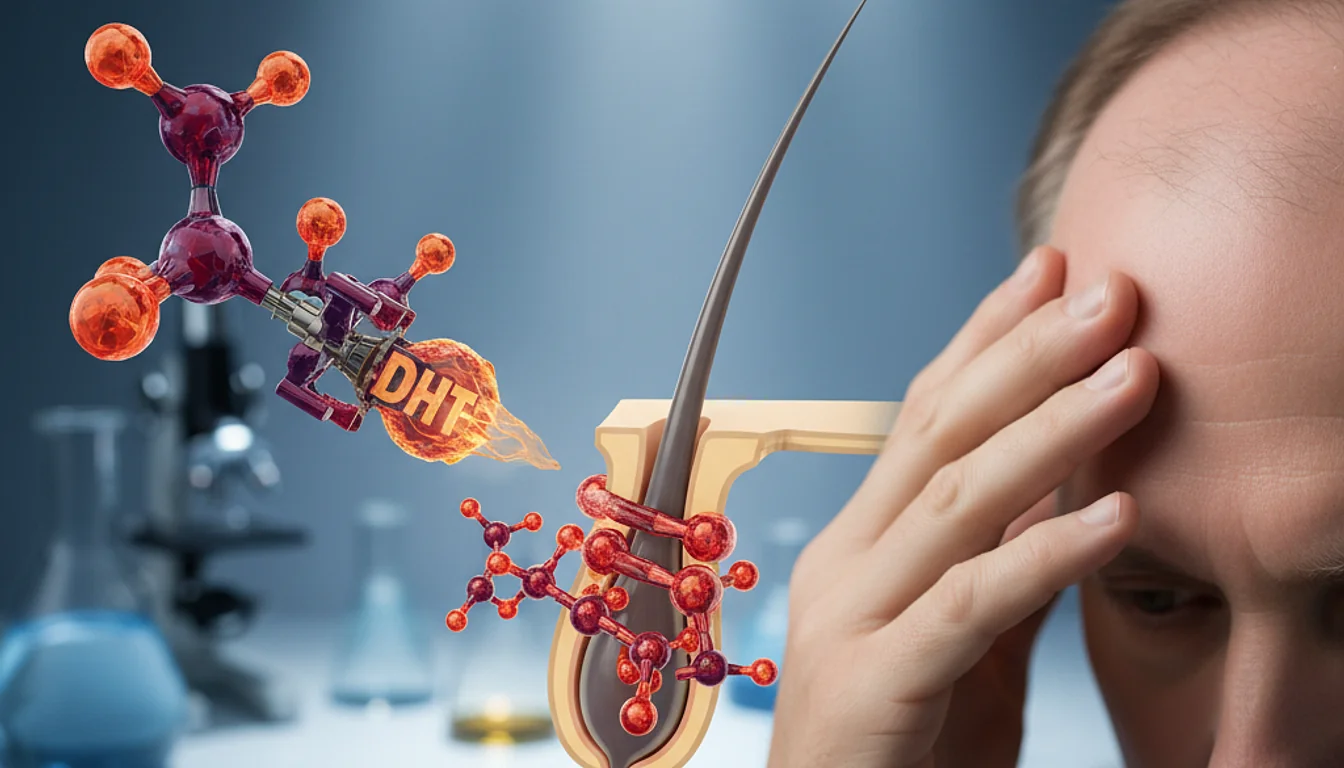
An enzyme called 5-alpha reductase converts about 10% of your testosterone into DHT. While DHT is great for developing “manly” traits when you’re a teenager, it’s a nightmare for your scalp once you hit your 30s. A 2023 study published in Nature Communications confirmed that DHT binds to androgen receptors in the hair follicle, triggering a process called miniaturization.
What is Miniaturization?
Imagine your hair follicle is a plant. DHT essentially acts like a weed killer that slowly restricts the water and nutrients. Every time your hair falls out and regrows, it comes back thinner, shorter, and lighter. Eventually, the follicle just gives up and closes shop. This is exactly what I saw happening to my temples when I turned 32. I’d look in the mirror and see these tiny, peach-fuzz hairs that never grew longer than half an inch.
My $1,200 Path of Failed Experiments
Before I understood DHT, I was a marketer’s dream. I was desperate and had a credit card. I remember walking into the CVS on Sunset Blvd and dropping $14.99 on a “Caffeine Infused Stimulating Shampoo” because the bottle looked scientific. I used it for three months. Result? My scalp felt tingly, but my drain was still clogged with hair every morning.
Then came the supplements. I bought a six-month supply of “Extra Strength” biotin gummies for about $45. They tasted like strawberry-flavored plastic and did absolutely nothing for my receding hairline. According to a 2024 review in the Journal of Clinical and Aesthetic Dermatology, biotin only helps if you have an actual deficiency, which is rare for most guys eating a normal diet.
I even saw a dermatologist who charged me a $250 consultation fee just to shrug and say, “It’s genetics, Alex. You can try Rogaine or just accept it.” He didn’t even mention DHT blockers. I left that office feeling like I was destined to be the “hat guy” for the rest of my life.
The Breakthrough: Blocking DHT at the Source
The turning point happened at 3:14 AM on a Tuesday. I was deep in a Reddit rabbit hole, looking at hair transplant clinics in Turkey, when I saw a comment about Roman. The guy mentioned that if you don’t stop the DHT, even a transplant won’t last because the surrounding hair will keep falling out.
I realized I had to stop the hormone, not just “nourish” the hair. There are two main ways to do this that are backed by actual science:
- Finasteride: An FDA-approved pill or topical that blocks the 5-alpha reductase enzyme. It lowers the DHT levels in your scalp by about 60-70%.
- Saw Palmetto: A natural alternative that some people swear by, but the American Academy of Dermatology notes it is significantly less effective than clinical options.
I was skeptical. I’d heard the horror stories about side effects, but I was more afraid of losing my hair. I took the free 2-minute quiz on Roman while waiting for a latte at Intelligentsia in Silver Lake. It was discreet, no insurance was needed, and a doctor reviewed my info within 24 hours. I opted for the topical Finasteride + Minoxidil spray because I liked the idea of targeting the scalp directly.
What 2 Years of DHT Blocking Actually Looks Like
If you’re looking for an overnight miracle, DHT blockers aren’t it. This is a game of patience. For the first three months, I honestly thought I was being scammed again. My hair actually looked thinner at first (which is a common “shedding” phase as old hairs make room for new ones).
But around the 6-month mark, something changed. I went to see my barber, Enzo, at his shop in Silver Lake. He stopped mid-snip and said, “Hey Turner, you doing something different? The crown is looking thicker.” That was the first time I felt like I wasn’t just delusional.

Now, two years later, I’m not rocking a 19-year-old’s mane, but my hairline has completely stabilized. No more “monk spot” on the back of my head. The cost is about $30 a month—less than I used to spend on those useless gummies and fancy shampoos.
The “Downside” Nobody Talks About
Let’s be real: you have to use this stuff forever. If I stop blocking the DHT, the hormone will just go back to work and my hair will start thinning again within a few months. It’s like brushing your teeth; it’s just part of my morning routine now. Also, some guys do experience side effects like scalp irritation. I had a bit of redness in the first week, but it cleared up once I stopped using too much product.
Action Plan: How to Start Fighting Back
If you’re noticing your forehead getting bigger or your hair looking “see-through” under bathroom lights, don’t wait three years like I did. Here is what I would tell my younger self:
- Get a diagnosis: Make sure it’s actually male pattern baldness (Androgenetic Alopecia) and not a thyroid issue or stress.
- Take the Roman Quiz: It’s free and gives you a professional starting point without the awkward doctor’s office visit.
- Take “Before” Photos: Your brain will play tricks on you. Take photos every month in the same lighting.
- Commit to 6 Months: Don’t even look for results until day 180. DHT takes years to kill a follicle; it takes months to revive it.
I’m just a guy who likes his hair, not a doctor. You should definitely consult a licensed physician before starting any medication. But from one guy to another: the science is real, and DHT is the enemy. Once you stop the hormone, the rest is just maintenance.
💬 Frequently Asked Questions
That’s the story. Make of it what you will.
Medical Disclaimer
This article is for informational and educational purposes only and is not intended as a substitute for professional medical advice, diagnosis, or treatment. Always seek the advice of your physician or other qualified health provider with any questions you may have regarding a medical condition. Never disregard professional medical advice or delay in seeking it because of something you have read in this article.