Receding Hairline at 25: Why It’s Happening and What to Do Now
Receding Hairline at 25: Why It’s Happening and What to Do Now doesn’t have to be complicated. I’ll prove it. If you’re seeing your hairline pull back, especially in your mid-twenties, it’s typically a sign of male pattern baldness, also known as androgenetic alopecia. This common condition is mostly genetic and hormonal, where hair follicles shrink over time, leading to thinning and eventually hair loss. The good news? You absolutely have options, and the sooner you act, the better your chances are of keeping (and even regrowing) your hair.
My name’s Alex Turner, and a few years ago, I wouldn’t have been able to tell you anything useful about stopping a receding hairline. Now, it’s pretty much part of my daily routine, and I run Gourmet Style Wellness, where I share honest experiences like this. Back when I was 32, I started noticing the dreaded M-shape forming on my forehead. It wasn’t 25, but the panic and confusion? Totally relatable. I spent years trying everything under the sun, wasting a ridiculous amount of money, before finally figuring out what actually works. I’m here to save you that headache and help you navigate what to do now.
Is Your Receding Hairline at 25 Just “Bad Luck” or Something More?
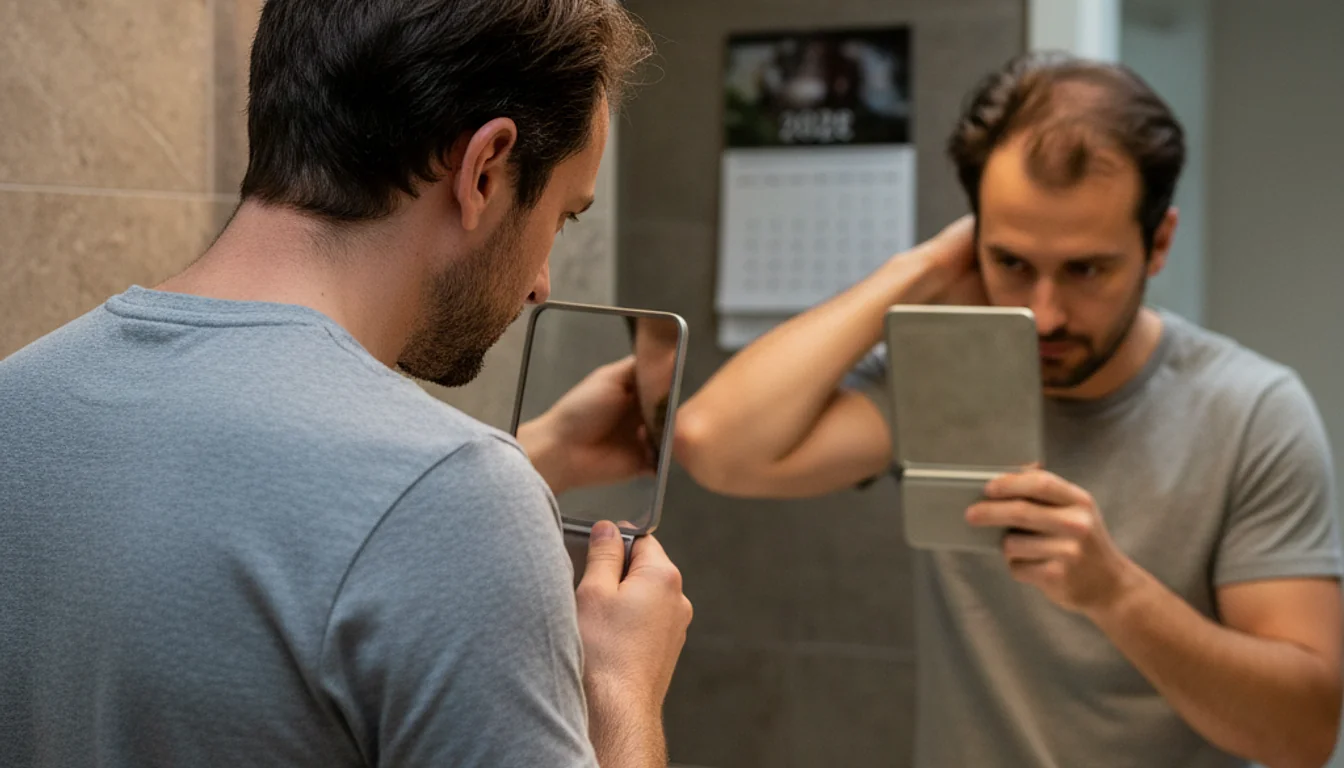
Honestly, when I first saw my hairline pulling back, I thought it was just bad lighting in the bathroom or maybe I was just imagining things. I’d pull my hair forward, trying to convince myself it was fine. But denial, as I quickly learned, doesn’t grow hair back. If you’re noticing a receding hairline at 25, the most common culprit by far is male pattern baldness (MPB), also called androgenetic alopecia.
The thing is, MPB isn’t really “bad luck” in the random sense. It’s largely genetic, passed down through your family tree, and driven by hormones. Specifically, a hormone called dihydrotestosterone (DHT) plays a huge role. If your hair follicles are sensitive to DHT – thanks, mom and dad – then DHT starts miniaturizing them. They get smaller, produce finer, shorter hairs, and eventually, stop producing hair altogether. It’s why you see that characteristic M-shape or a thinning crown.
I remember my dad always joked about his “five-head” rather than a forehead, and honestly, seeing my own hairline start to mirror his was a bit of a punch to the gut. For years, I just accepted it as my destiny. But, to be fair, there are other, less common reasons why you might experience hair loss at a young age, like certain medical conditions, medications, or even significant stress. But for a distinct receding hairline, especially starting in your twenties, it’s almost certainly MPB. You can dive deeper into how genetics play a role in all this by checking out Is Hair Loss Genetic? My Family History and What It Means for You.
The Emotional Toll of a Receding Hairline
Let’s talk about the elephant in the room: how it feels. When I was 34, I started wearing hats indoors, even at my old graphic design office. It was less about fashion and more about trying to hide what felt like a giant spotlight on my thinning hair. I’d avoid overhead lights, angle myself away from reflective surfaces, and generally just felt less confident. That feeling of losing control, of your appearance changing in a way you can’t stop, is truly awful. I’ve been there, and if you’re feeling that way now at 25, you’re not alone. It messes with your self-image, your dating life, even how you interact with friends. It’s a real mental struggle.
My Wasted Years and the “Receding Hairline at 25” Money Pit
Before I found something that actually worked, my hair loss journey was a masterclass in throwing money down the drain. I tried everything. Seriously, you name it, I probably bought it. This was back in 2020-2022, before I really understood what was going on. I was desperate.
- Caffeine shampoos: Remember those? I bought a fancy German brand that cost me like $28.99 for a tiny bottle. The marketing promised “energy for your hair roots.” What it delivered was a clean scalp and absolutely no regrowth. Zip. Zilch. Nada.
- Biotin gummies: Oh, the biotin gummies. I went through tubs of these things, convinced that if I just ate enough tasty, sugary vitamins, my hair would magically thicken. My nails got stronger, sure, but my hairline? Still doing its disappearing act. I think I spent close to $150 on various brands of these over about eight months.
- “Natural” remedies: I got sucked into the world of essential oils, scalp massages, and even a weird inversion method I saw on YouTube. There was this one expensive scalp serum, about $60 a bottle, that smelled like a pine forest and felt like nothing. My college roommate, Dave, actually tried it with me for a bit, saying his hair felt “fresher.” Neither of us saw any hair growth. It was pure placebo.
- The Pricey Dermatologist: Finally, I decided to go pro. I booked an appointment with a highly-rated dermatologist in Santa Monica. After a quick look and a few questions, she basically said, “Yep, it’s genetics. Welcome to the club.” Total cost for a five-minute consultation: $180, and that was with my insurance! I left feeling even more defeated, convinced there was no real solution for my receding hairline.
It was frustrating, embarrassing, and frankly, a huge waste of my hard-earned cash. I wish I could go back in time and tell my 35-year-old self to skip all that nonsense. My frustration peaked in early 2023 when I was literally up at 3 AM googling “hair transplants Turkey cost” because I felt like I had no other options. I don’t want you to go through that same cycle of hope and disappointment.
The Turning Point: A Real Solution for My Receding Hairline at 25 (Even Though I Was 35)
The real breakthrough came after a casual conversation with an old friend. He’d noticed my hat collection growing and, being a stand-up guy, pulled me aside. “Dude,” he said, “have you looked into Roman for your hair?” I was super skeptical, honestly. After all the failed attempts, “Roman” sounded like another slick marketing ploy. But he insisted it was different, that it was legitimate medical treatment, just delivered conveniently.

What really got me was the idea of a free, quick online quiz. No more awkward doctor visits where they just shrugged. No insurance hassles. Just a few questions from the privacy of my own home. I figured, what’s another two minutes out of my life? I hopped on Roman’s site in February 2023, took the quiz, and answered some straightforward questions about my health and hair loss. It was surprisingly easy and discreet.
Within a day or two, I heard back. A licensed physician reviewed my info and recommended their topical finasteride + minoxidil spray. I’d heard of minoxidil (Rogaine), but finasteride sounded intimidating. The doctor explained it all clearly: finasteride blocks DHT, and minoxidil stimulates growth. Combining them topically seemed like a smart approach. The whole process felt legitimate, not like some snake oil salesman.
My Roman Journey: From Skepticism to “Wait, Is That… Hair?”
I started the treatment in early March 2023. It was a simple, once-a-day spray. Consistency was key, and for once, I was motivated because it felt like a real medical solution, not a miracle cure. For the first few months, nothing. I mean, absolutely nothing dramatic. I was still checking my scalp in my tiny bathroom with the bad lighting every single morning, hoping to see something, anything.
Then, around the six-month mark – so, late August 2023 – I went for a haircut. My barber, Leo, who’d seen my hairline slowly retreat over the years, paused. He actually put his clippers down and said, “Hey, Alex, what have you been doing? Your hairline looks… denser.” He even pointed out some little baby hairs popping up where it used to be barren. I was floored. My barber, a professional who sees hundreds of scalps a month, noticed. That was the social proof I needed!

That moment was pure excitement. It wasn’t just me imagining things anymore. There was real, tangible regrowth. My confidence started to creep back. I still wore hats, but now it was for style, not to hide. You can read a more detailed account of my experience and see how the Roman plan works from quiz to results by checking out Roman Hair Loss Plan Guide: From Quiz to First Results.
What to Do Now: Your Action Plan for a Receding Hairline at 25
Okay, so you’ve got a receding hairline at 25. You’ve heard my story. Now, what can you actually do? My advice is to skip all the years and money I wasted and go straight for what’s proven to work. Here’s the plan I’d give to my younger self, or to any friend dealing with this:
1. Understand the Science (Briefly)
You don’t need a medical degree, but knowing the basics helps. We’re talking about blocking DHT and stimulating growth. That’s the one-two punch that most effective treatments use. Finasteride tackles DHT, and minoxidil wakes up those sleepy follicles. When you combine them, especially in a topical spray, you often get better results with fewer systemic side effects.
2. Consider a Medically-Backed Online Solution
This is where Roman comes in for me. I know I earn a commission if you sign up through my links, and I’m totally transparent about that. But I wouldn’t recommend it if I didn’t use it myself and if it hadn’t genuinely changed things for me. Why Roman works, in my opinion, especially for a receding hairline at 25:

- Convenience: No more endless doctor waits. The whole process is online, from quiz to prescription.
- Discreet: Your consultation is private, and your treatment arrives in unmarked packaging. No one needs to know your business unless you tell them.
- Affordable: Compared to individual doctor visits and prescriptions, it’s pretty cost-effective. My monthly supply usually runs me around $23.47, which is a fraction of what I used to spend on useless stuff.
- Effective Ingredients: They use FDA-approved ingredients (finasteride and minoxidil) in a combined topical formula. This means you’re getting actual medication, not just vitamins.
The whole process starts with their free, 2-minute online quiz. It’s truly no obligation. They’ll ask about your medical history, your hair loss pattern, and what you’re hoping to achieve. A licensed physician then reviews your answers and, if appropriate, prescribes a custom treatment plan. It’s that simple.
3. Be Consistent and Patient (This Isn’t an Overnight Fix)
This is key. I’ve been using Roman’s spray for over two years now (it’s December 2025 as I write this). My hairline is stable, my crown has filled in, and my confidence is back. But it took time. Expect to wait at least 3-6 months to see any noticeable results. Real regrowth can take up to a year or even longer. You have to make it a part of your daily routine, like brushing your teeth. If you stop, the hair loss will likely resume.
I had to learn this the hard way with my initial impatience. I almost gave up around month three because I wasn’t seeing huge changes. Luckily, my inner pragmatist kicked in and reminded me that real medical changes take time. Honestly, the daily application became second nature pretty quickly.
FAQs About Receding Hairline at 25: Why It’s Happening and What to Do Now
Does Receding Hairline at 25: Why It’s Happening and What to Do Now actually work?
From my personal experience, yes, absolutely. For me, Roman’s topical finasteride and minoxidil spray has been incredibly effective. My barber noticed regrowth, and my hairline is stable and much fuller than it was two years ago. The ingredients, finasteride and minoxidil, are FDA-approved and clinically proven to treat male pattern baldness. While individual results can vary, a significant percentage of men see positive results, either stopping further hair loss or experiencing regrowth, especially when starting early like at 25.
How do you use Receding Hairline at 25: Why It’s Happening and What to Do Now?
Using the topical finasteride and minoxidil spray is super straightforward. My Roman treatment comes in a small spray bottle. I apply a specific number of sprays (as directed by the physician’s instructions) directly to the affected areas of my scalp – usually my temples and hairline – once a day. I make sure my hair and scalp are dry, spray it on, and then gently massage it in with my fingertips. After that, I just let it air dry for a few minutes before styling my hair. It really takes less than a minute of my day.
How long does Receding Hairline at 25: Why It’s Happening and What to Do Now last?
When we talk about “how long it lasts,” we’re usually talking about the treatment itself and the results you see. The treatment (finasteride and minoxidil) is generally a long-term commitment. You need to keep using it to maintain the results. If you stop, the hair loss process that was being managed will likely resume, and any new hair growth will probably fall out over time. For me, it’s been over two years, and I fully expect to continue using it daily to keep my hairline where it is. Think of it like taking a vitamin or exercising – you do it consistently for ongoing benefits.
Final Thoughts: Taking Control of Your Receding Hairline
Look, seeing a receding hairline at 25 sucks. There’s no way around it. It can feel disheartening, confusing, and like something you just have to live with. But my journey, starting from denial and frustration to finally finding a real solution, taught me that you don’t have to just accept it.
My biggest takeaway is this: act early. The sooner you address male pattern baldness, the better your chances of saving your existing hair and even regrowing some of what you’ve lost. Don’t waste your time and money on gimmicks like I did. Go for the medically-backed solutions.
The essentials: Understand it’s likely genetic, act quickly, and use proven treatments like topical finasteride and minoxidil. That’s it. If you’re ready to stop stressing and start doing something about your receding hairline, I genuinely recommend taking Roman’s free, 2-minute online quiz. It’s private, convenient, and could be the turning point you’re looking for.
Remember, I’m not a doctor — consult a licensed physician or healthcare professional to discuss your specific situation and treatment options.
Medical Disclaimer
This article is for informational and educational purposes only and is not intended as a substitute for professional medical advice, diagnosis, or treatment. Always seek the advice of your physician or other qualified health provider with any questions you may have regarding a medical condition. Never disregard professional medical advice or delay in seeking it because of something you have read in this article.